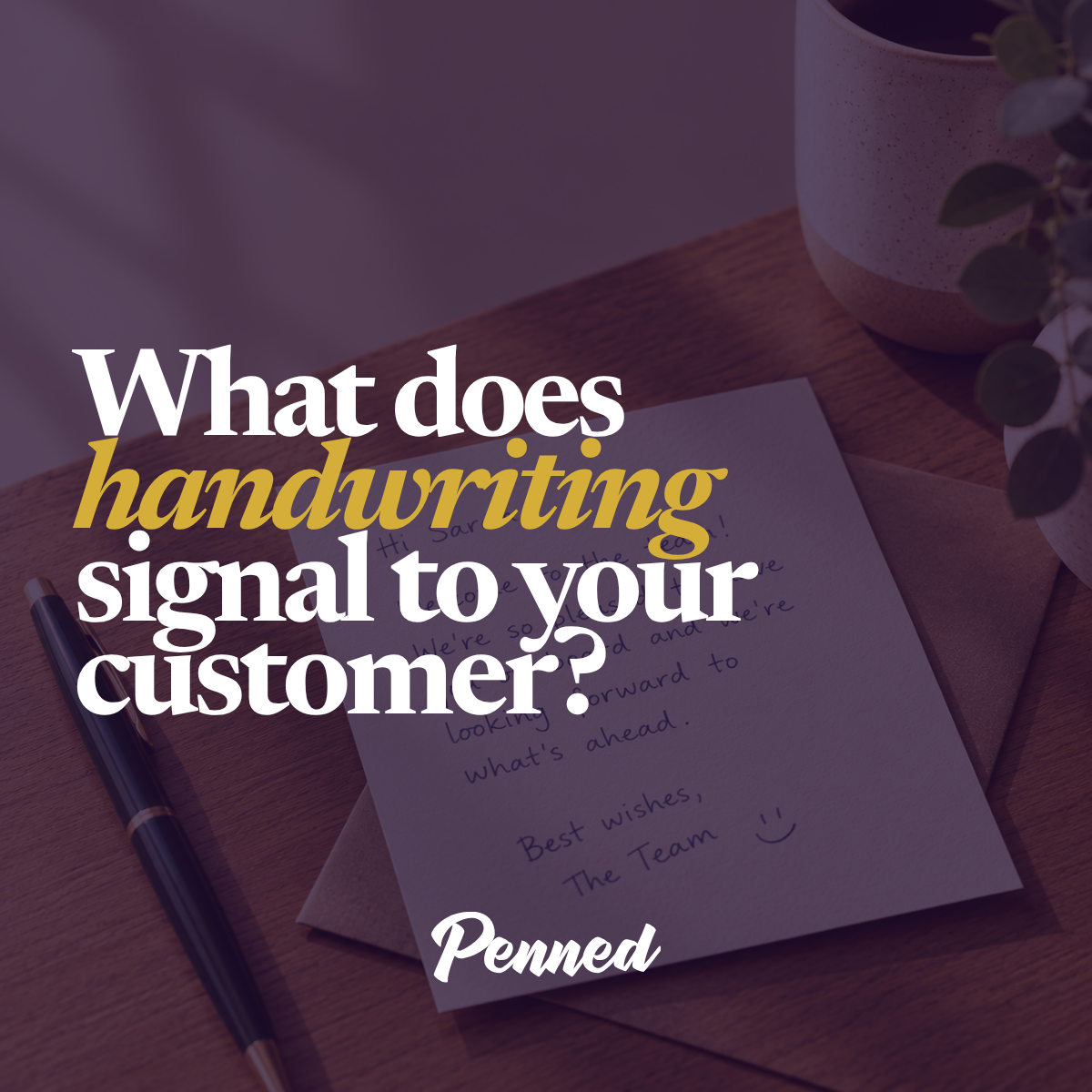
Think about the last handwritten letter you received. Not a birthday card, definitely not a bill — a genuine letter. There's something about it that makes you pause, because it's so rare. You look at the handwriting, you notice the way the ink sits on the paper. You might even wonder who wrote it before you open it.
That's the interesting thing about handwriting: it communicates before you've read the first sentence.
What does handwriting communicate?
Handwriting can communicate more than the words on the page. In a marketing context, it can signal effort, warmth, care and personal attention — particularly when the message itself is relevant and the wider customer experience lives up to it.
Handwriting says: someone made an effort
Typing is efficient, and that's one of its biggest strengths. You can write an email, copy it, personalise the name and send it to 10,000 people in minutes — it's no wonder email is the communication channel of choice for most businesses.
Handwriting is different. It has traditionally been associated with effort, because writing by hand takes more physical involvement than typing. Research backs this up: a study published in the Journal of Services Marketing found that handwritten messages generated stronger feelings of warmth than printed messages, with perceived effort and psychological closeness helping explain the difference.
In other words, the format itself can change how the message feels — and that's powerful for a brand.
Why handwriting feels personal
There's an important distinction here. Personalisation is usually about the content: "Hi Sarah." "Your renewal is due on 14 June." "Here's your unique discount code." All useful — but handwriting adds something different. It makes the message feel personal before the recipient has even processed the words. A handwritten name on an envelope feels different from a printed one. A handwritten thank-you feels different from an automated "thanks for your purchase" email.
The content might be similar, but the experience isn't.
It can signal care
Imagine two brands. The first sends:
THANK YOU FOR YOUR PURCHASE.
The second sends a handwritten note:
Neither message is particularly complicated, but the second feels like somebody took a moment to write to you. And that's the signal. Not necessarily luxury. Not necessarily exclusivity.
Care.
And that's particularly useful when your product or service relies on trust and relationships.
Handwriting can create a sense of exclusivity
There's another reason handwriting stands out: it doesn't feel mass-produced in quite the same way. Even when a handwritten piece is being sent to hundreds or thousands of people, the combination of handwriting and personal details can make it feel more individual than a standard mass-produced message.
Penned helps businesses send personalised handwritten letters, notes and cards at scale, using variables such as names, codes and dates.
But handwriting isn't a magic trick
There's an important caveat: handwriting can't rescue a poor customer experience.
A study into handwritten service communication found that the positive effect of handwriting disappeared when the quality of the underlying service was poor — and that makes sense. If your delivery is late, your product doesn't work and nobody answers the phone, a lovely handwritten card might help, but it won't rebuild the trust lost in the experience.
Handwriting works best when it reinforces something that's already good. It's the extra touch — not the whole experience.
Why handwriting stands out in modern marketing
We live in a world where a huge amount of brand communication is instant — emails, notifications, texts, automated reminders, social posts. Everything is designed to arrive quickly and move quickly. That's exactly why something slower can stand out.
A physical piece of mail doesn't arrive in a notification tray. It arrives at someone's home or office. It occupies physical space and asks to be picked up.
Penned's own approach is built around that idea: real pen, real paper and natural variation, rather than simply using a handwriting-style font.
What does your brand want to signal?
Before sending handwritten mail, ask yourself what you want the recipient to feel. Do you want them to feel:
Then write the message accordingly, so the handwriting gets their attention. The words create the feeling, and the experience reinforces your brand.
The key takeaway
Handwriting doesn't make a message more important simply because it's handwritten — it makes the message feel different. It can signal effort, create warmth and make a brand feel more human.
And in a world where so much communication arrives typed, polished and instantly forgettable, that's a useful thing to be able to signal.
Sometimes, the most modern thing a brand can do in the world of AI is make something feel a little more human.
Sources
The research referenced in this article includes:
- Ren, X., Xia, L. & Du, J. (2018), "Delivering warmth by hand: customer responses to different formats of written communication", Journal of Services Marketing. The study explores how handwritten versus printed messages affect feelings of warmth, perceived effort and psychological closeness. Read the study on ScienceDirect.
- Mathur, S. & Nayak, J. K. (2025), "Say it with a note: leveraging written relational communication to shape brand authenticity perceptions online", European Journal of Marketing. The research examines how written communication from online retailers can influence perceptions of brand authenticity, including through feelings of warmth and perceived effort. Read the research.